Praxis 5362-CALLA & CALP:認知學術語言能力與語言學習法的關係

Updated: Aug 6
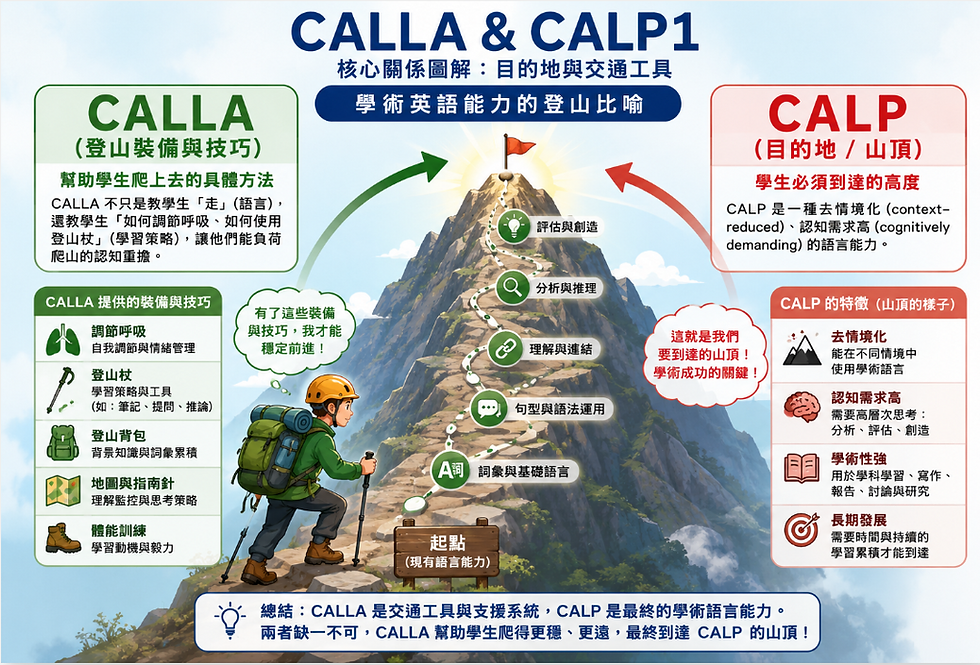
1. 核心關係圖解:目的地與交通工具
如果把學術英語能力比喻成登山:
CALP (目的地/山頂): 是學生必須到達的高度。這是一種去情境化 (context-reduced)、認知需求高 (cognitively demanding) 的語言能力。
CALLA (登山裝備與技巧): 是幫助學生爬上去的具體方法。它不只是教學生「走」 (語言),還教學生「如何調節呼吸、如何使用登山杖」 (學習策略),讓他們能負荷爬山的認知重擔。
比較項目 | CALP (Cummins) | CALLA (Chamot & O'Malley) |
全名 | Cognitive Academic Language Proficiency (認知學術語言能力) | Cognitive Academic Language Learning Approach (認知學術語言學習法) |
性質 | 能力指標 (Competence) | 教學模式 (Instructional Model) |
核心概念 | 區分 BICS (生活語言) 與 CALP (學術語言)。強調學術語言需要 5-7 年才能發展成熟。 | 整合 內容 (Content)、語言 (Language) 與 學習策略 (Learning Strategies) 三位一體。 |
角色 | 定義了「學生需要學會什麼」才能在學科上成功。 | 提供了「教師該如何教」才能加速學生獲得上述能力。 |
關鍵痛點 | 指出為何許多學生雖然口語流利 (BICS 好),但在學業表現上卻失敗 (CALP 不足)。 | 針對這個痛點,提供具體的策略教學 (如:做筆記、圖像化、自我監控) 來解決。 |
3. CALLA 如何具體支持 CALP?
CALLA 是為了讓學生在還沒有完全掌握語言的情況下,就能處理高難度的學科內容 (即 CALP 的要求)。它透過以下三個策略來「搭鷹架」 (Scaffold):
後設認知策略 (Metacognitive Strategies):
CALP 需求: 學生需要能獨立規劃讀書計畫、監控理解程度。
CALLA 訓練: 教師明確教導學生如何「計畫 (Planning)」、「監控 (Monitoring)」和「評估 (Evaluating)」自己的學習。
認知策略 (Cognitive Strategies):
CALP 需求: 學生需要能分析複雜文本、歸納邏輯。
CALLA 訓練: 教師教導具體技巧,如「做筆記 (Note-taking)」、「歸納 (Grouping)」、「推論 (Inferencing)」。
社會情感策略 (Social/Affective Strategies):
CALP 需求: 學生需要在困難的學術挑戰中保持自信與動機。
CALLA 訓練: 教導學生「提問以澄清 (Questioning for clarification)」或「自我對話 (Self-talk)」來降低焦慮。
More details:
1. Metacognitive Strategies (Planning & Monitoring)
These strategies help students "think about their thinking." They act as the "executive control" of learning.
Advance Organization (先行組織):
What it is: Previewing the main ideas and concepts of the material to be learned (skimming the text for headings, looking at pictures).
Example: "Before we read this chapter on photosynthesis, let's look at the bold headings and the diagrams to guess what the main steps are."
Selective Attention (選擇性注意):
What it is: Deciding in advance to attend to specific aspects of language input or situational details that will assist in performance.
Example: "While watching this video about the water cycle, focus only on the words that describe movement (like rise, fall, flow)."
Self-Monitoring (自我監控):
What it is: Checking one's comprehension during listening or reading, or checking the accuracy and/or appropriateness of one's oral or written production while it is taking place.
Example: "Wait, that sentence didn't make sense. Let me re-read it to see if I missed a key word."
Self-Evaluation (自我評估):
What it is: Judging how well one has accomplished a learning activity after it has been completed.
Example: "I wrote down 5 key words, but I forgot to write the definition for two of them. Next time I need to be faster."
2. Cognitive Strategies (Interacting with Material)
These strategies are used to physically or mentally manipulate the material to be learned.
Note-Taking (做筆記):
What it is: Writing down key words or concepts in abbreviated verbal, graphic, or numerical form.
Example: Teaching students to use the Cornell Note system or simply T-charts to separate main ideas from details.
Grouping / Classifying (歸納/分類):
What it is: Ordering, classifying, or labeling the material used based on common attributes.
Example: "Sort these animals into two groups: those that live in water and those that live on land."
Elaboration (精緻化/聯想):
What it is: Relating new information to prior knowledge, relating different parts of new information to each other, or making meaningful personal associations.
Example: "This word 'democracy' reminds me of our class voting for the class leader."
Imagery (圖像化):
What it is: Using mental or real images to understand or represent information.
Example: "Draw a picture in your mind of what the character looks like based on this description."
Inferencing (推論):
What it is: Using available information to guess meanings of new items, predict outcomes, or fill in missing information.
Example: "I don't know the word 'glacier,' but the text says it is 'ice' and 'moves slowly,' so I guess it's a big moving ice block."
3. Social/Affective Strategies (Interacting with Others)
These strategies involve interacting with another person to assist learning or using emotional control to assist a learning task.
Questioning for Clarification (提問澄清):
What it is: Asking a teacher or peer for additional explanation, rephrasing, or examples.
Example: Teaching students phrases like "Could you please repeat that?" or "Does this mean...?"
Cooperation (合作學習):
What it is: Working together with one or more peers to solve a problem, pool information, check a learning task, or get feedback on oral or written performance.
Example: "Think-Pair-Share" activities where students must discuss an answer with a partner before sharing with the class.
Self-Talk (自我對話):
What it is: Reducing anxiety by using mental techniques that make one feel competent to do the learning task.
Example: "I can do this. I prepared for this presentation. Just take a deep breath."
Category | Goal | Key Strategy Keywords |
Metacognitive | Executive Control (Planning/Checking) | Plan, Monitor, Evaluate, Organize |
Cognitive | Mental Processing (Doing/Thinking) | Note-take, Summarize, Group, Image, Deduce |
Social/Affective | Interaction & Emotion (Feeling/Talking) | Ask Questions, Cooperate, Self-talk |
💡 老師的重點總結 (Key Takeaway)
CALP 是理論上的「學術門檻」,而 CALLA 是跨越這個門檻的「實戰策略」。
在考試或教學反思中,只要記住這個邏輯鏈:
學生具備 BICS (2年) ➔ 遇到學術瓶頸 (需要 CALP) ➔ 教師運用 CALLA 模式 (融入學習策略) ➔ 加速學生發展出 CALP (縮短原本需要的 5-7 年差距)。
Two specific application directions for how CALLA (method) supports CALP (target) :
Part 1: Exam Applications
These types of questions usually present a scenario to test your ability to distinguish between BICS and CALP and select CALLA as the solution.
Example Question 1: Identifying Student Needs (Distinguishing Between BICS and CALP)
Question: Jose, a fifth-grade immigrant student, has just transferred to this school. He chats fluently with his classmates in English on the playground, without any communication barriers. However, when he reads an article about the American Revolutionary War in social studies class and is asked to write a summary, he struggles greatly, displaying a limited vocabulary and numerous grammatical errors. According to Cummins' theory, which of the following explanations is most accurate?
(A) Jose may have a learning disability and needs to be referred for special education assessment. (B) Jose lacks motivation to learn and only enjoys socializing. (C) Jose already possesses BICS, but has not yet developed sufficient CALP to handle academic tasks. (D) Jose's native language interferes with his English writing.
✅ Correct Answer: (C) 👩🏫 Explanation: This is a classic BICS/CALP trap question. Teachers are often misled by students' fluent spoken English (BICS), assuming their academic ability is also fine. This question establishes the "target": what students lack is CALP .
Example Question 2: Choosing a Teaching Strategy (Application of Calla)
Question: Teacher Wang noticed that her bilingual students often struggled with long, complex sentences and technical terms in their science textbooks. To help them achieve Academic Language Proficiency (CALP), Teacher Wang decided to use CALLA (Cognitive Academic Language Learning Method). Which of the following teaching activities least conforms to the spirit of CALLA?
(A) The teacher demonstrates how to use a "Graphic Organizer" to summarize the key points of the text. (B) The teacher asks students to repeatedly memorize the new vocabulary in the text until they know it by heart. (C) Before teaching, the teacher asks students about their prior knowledge of the topic (Preparation). (D) The teacher instructs students to use context to infer the meaning of unfamiliar words (Inference).
✅ Correct answer: (B) 👩🏫 Explanation:CALLA's core focus is teaching "learning strategies" .(A) is a cognitive strategy (induction).(C) is the first step (preparation) of the five steps of CALLA.(D) is a cognitive strategy (inference).(B) is rote memorization, which belongs to behaviorism, and is not the metacognition or strategy application emphasized by CALLA. This question establishes the "method": CALLA focuses on teaching students "the method of fishing" (strategy) .


Comments