From Learning to Transfer: ATL Skills in Action Through a Language & Culture Exchange Project (Secondary)

Updated: Sep 9
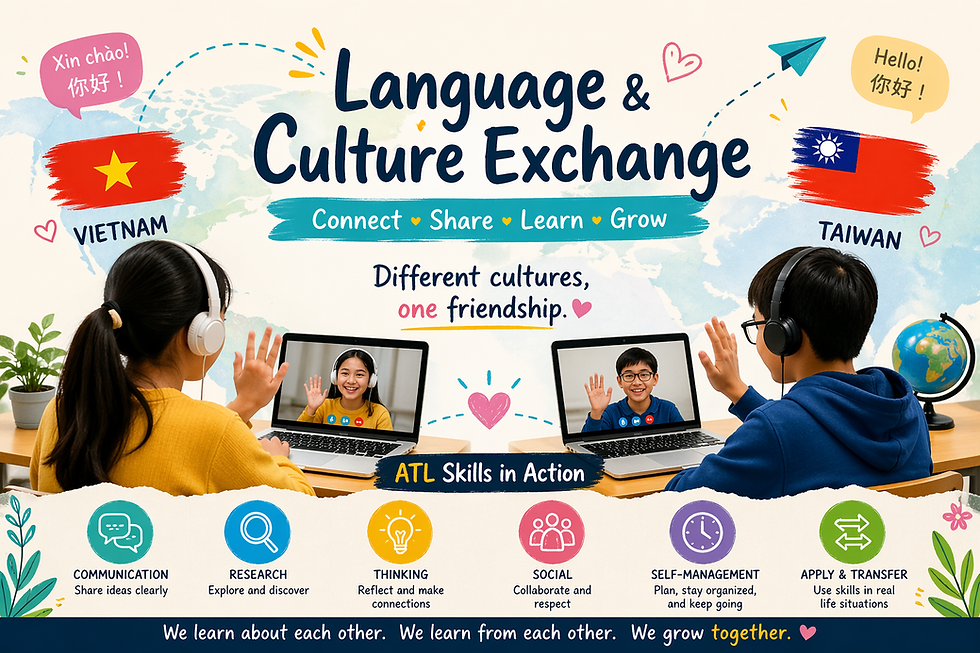
In this project, I led the overall instructional design, curriculum planning, cross-school collaboration, and implementation, working with Mr. Kenny Fang, Bilingual Scouting Teacher at Nanxing Junior High School (NSJH), Taiwan, to facilitate authentic cross-cultural language learning between students in Taiwan and Vietnam.
The project is grounded in ATL (Approaches to Learning) and goes beyond communication skills to focus on how students meaningfully apply and transfer their learning to real-world contexts. Through authentic interaction with international partners, students used their target language to share ideas, ask and respond to questions, and explore cultural differences. They also reflected on how these language and ATL skills could be applied in new situations, such as travel, everyday communication, and future global collaboration.
1. Context & Rationale(教學脈絡)
This project was designed as an authentic language and cultural exchange between Vietnamese and Taiwanese students.
The purpose of this learning experience was to:
provide a meaningful, real-world context for language use
develop students’ intercultural understanding
support students in applying and transferring ATL skills beyond the classroom
Rather than focusing on memorisation, this project intentionally emphasized:👉 communication in authentic contexts👉 inquiry-based learning👉 student agency and reflection
2. Learning Objectives(學習目標)
Students will be able to:
communicate ideas clearly in a real-world context (Communication Skills)
research and organize information about cultural topics (Research Skills)
analyze and compare cultural similarities and differences (Thinking Skills)
collaborate effectively with international peers (Social Skills)
manage time, emotions, and responsibilities (Self-Management Skills)
apply and transfer language skills to authentic situations (Transfer Skills)
3. ATL Skills Mapping(對齊 IB ATL)
ATL Category | In Action (Student Experience) |
Social | Partner collaboration, intercultural communication |
Research | Finding information about food, culture, daily life |
Thinking | Comparing cultures, reflecting on learning |
Communication | Presentations, Padlet recordings, Q&A with partners |
Self-Management | Planning, meeting deadlines, managing emotions |
Transfer | Applying classroom Chinese/English in real interactions |
*差異
溝通技能 (Communication) 是「表達與理解的技術」。 當孩子在鍛鍊溝通技能時,他們在練習:如何把長篇大論濃縮成重點?如何針對不同受眾切換說話方式?如何看懂一篇文章背後的意涵?
社交技能 (Social) 是「與人互動的藝術」。 當孩子在鍛鍊社交技能時,他們在練習:當組員意見不同時如何解決衝突?如何積極傾聽並給予他人建設性的回饋?如何承擔團隊責任而不是只顧自己?
4. Learning Process(學習歷程)
Phase 1: Inquiry
Students explored authentic and relatable topics such as daily life, local food (e.g., “Introduce Your Meals” and “Must-Try Foods in Our Country”), and cultural practices. They also generated their own questions for their Taiwanese partners (“My Curiosity”), which helped spark genuine curiosity and gave students a strong sense of ownership from the very beginning.
Many students showed natural engagement when the topics connected to their real lives, and they became more willing to ask questions and explore beyond the textbook.
Phase 2: Collaboration
Students worked in pairs or small groups and engaged in meaningful interaction with their Taiwanese partners. Through Padlet posts, voice recordings, and written responses, they exchanged ideas, asked questions, and responded to different perspectives.
Some students demonstrated strong collaboration skills, even when they had different opinions:
💬 “We had different opinions but could still work well together. —G8 Student”
Others highlighted how the experience helped them grow in confidence:
💬 “I learned to listen to others and share my opinions with confidence. —G8 Student”
These reflections show not only the development of social skills, but also students’ ability to navigate intercultural communication with respect and openness.
Phase 3: Creation
Students created a variety of meaningful outputs, including Christmas or Lunar New Year cards exchanged between countries, recorded presentations, Padlet posts, and bilingual communication tasks.
These tasks required students to actively use language to express real meaning, rather than relying on memorisation. For example, several students shared that recording their speech was both challenging and rewarding:
💬 “When I tried to record the speech, I became better at expressing my ideas clearly.” — G7
Students also demonstrated growing confidence in using language for authentic communication, rather than just completing a task.
In addition, students developed authentic research skills by using digital tools:
💬 “I used websites and videos to collect information and learned how to choose reliable sources.” 💬 “I was surprised by how much information is available online.” — G7
This reflects increasing independence in learning, as well as students’ ability to evaluate information critically.
Beyond academic skills, some students also connected their work to meaningful human experiences. For example:
💬 “When you received our cards and shared your thoughts, it meant a lot to me.” — G7
This highlights that the creation phase was not only about producing work, but also about building genuine connections through language and culture.


Phase 4: Reflection(ATL in Action)
Students completed structured self-reflections focusing on ATL skill development, including communication, research, thinking, social, and self-management skills.
Their reflections showed a range of depth:
some students identified specific skills they developed
others described how they applied these skills in the project
more advanced students demonstrated transfer to real-life and future contexts
For example:
💬 “I use what I learned in class to communicate with my friends.”💬 “In the future, I can use these skills to better understand Chinese people.”— G8
💬 “These skills will be useful in my future studies and daily life.” — G7
Some students also expressed deeper personal insights, particularly in terms of intercultural understanding:
💬 “I realized that friendship is not about distance—we can still be friends even if we have different cultures.” — G7
These responses highlight students’ growing metacognitive awareness, as well as their ability to connect classroom learning to real-world experiences and future possibilities.

5. Assessment Design(評量設計)
Assessment in this project focused on ATL skill development rather than content knowledge alone.
Key criteria included:
Communication
Social Collaboration
Thinking
Self-Management
Applying & Transferring Skills (core focus) ⭐
Students were assessed using a 4-level rubric:
Beginning
Developing
Proficient
Advanced
A key strength of the assessment design was the emphasis on transfer, ensuring that students were not only learning language, but also applying it in authentic contexts.
6. Evidence of Student Learning(學生學習證據)
Student outcomes collected through Padlet demonstrated a clear progression in ATL skill development.

Evidence of Student Learning (Padlet):
👉 These responses demonstrate:
real-world application of language skills
development of collaboration and communication
emerging ability to transfer learning beyond the classroom
increasing metacognitive awareness
7. Reflection on Teaching Practice(教師反思)
What Worked Well / Key Success
The biggest success of this project was seeing what happened when students had a real reason to use the language they were learning.
I noticed a clear difference when students were communicating with real people rather than simply completing a textbook exercise. They had something they genuinely wanted to say, ask, or share, and I saw them become more willing to speak, ask questions, and take risks with their language.
One moment that stayed with me was when a Vietnamese student recorded a self-introduction in Chinese and said that she felt her Chinese was not good enough. Her Taiwanese partner encouraged her and even recorded her own introduction again so the student could listen and practice.
Another memorable moment came from a translation mistake when a student ended up saying that she ate “shampoo” for dinner. Instead of correcting the mistake myself, I asked students why it had happened and what they could do differently next time. They came up with their own ideas for checking information. Moments like these reminded me that some of the best learning happens in ways I did not completely plan.
The Christmas and Lunar New Year card exchange was another highlight. Students created something for a real person in another country, so when they met online, they already had something meaningful to talk about. They were not speaking because I had assigned them a speaking task. They had a genuine reason to communicate.
I also learned a lot from students’ reflections. Some students could identify an ATL skill easily, but they were not always able to explain when they had used it or what they had learned from the experience. This made me realize that reflection cannot simply be added at the end of a project. Students need to be taught how to reflect and supported in moving from “I learned this skill” to “This is how I used it, this is what happened, and this is how I can use it again.”
That became one of my biggest takeaways. I started to see ATL skills less as labels on a lesson plan and more as skills that students could notice, practise, discuss, and apply.
Most importantly, the project changed the way I think about language learning. The goal was not simply for students to learn more Chinese, but to use language to connect with others, solve problems, understand different perspectives, and reflect on their own learning.
The language was the starting point, but the learning went far beyond language.
Challenges
One of the main challenges was that this project was not part of the formal assessed curriculum. Because it was not graded, some students became less motivated and more passive in their participation.
Another challenge was logistical. Due to my limited Vietnamese and unfamiliarity with updated postal regulations, I experienced significant difficulty communicating with the post office. As a result, the gifts sent from the Taiwanese partner school were returned, which was disappointing for both students and our partners.
Responses
To address student motivation, I intentionally aligned the project more closely with my regular lessons. I integrated it into lesson objectives and incorporated ATL-based reflection tasks, helping students understand that the project was not an “extra activity,” but a meaningful part of their learning. This significantly improved student engagement.
To respond to the logistical challenge, I shifted the focus from physical exchange to digital interaction. Students continued to communicate through Padlet, recordings, and messages, which maintained the authenticity of the exchange.
I also used this situation as a real-world learning opportunity, encouraging students to reflect on global communication, problem-solving, and adaptability.
Professional Growth
This experience strengthened my understanding of the importance of:
aligning innovative projects with curriculum and assessment
maintaining flexibility when unexpected challenges arise
supporting student engagement through clear purpose and structure
On a personal level, navigating communication barriers with the post office was stressful, but it became a meaningful opportunity for growth. It strengthened my resilience and reminded me of the concept of “Sisu”—the ability to stay determined and composed in the face of challenges.
Overall, this experience has made me more adaptable, reflective, and intentional in my teaching practice, especially when designing authentic, real-world learning experiences that promote transfer.
8. Next Steps(未來發展)
To further enhance this unit, I plan to:
incorporate more student-led inquiry to increase ownership
Instead of providing fixed topics, students will design their own inquiry questions based on their interests.
For example:
“What are the differences between school lunch in Taiwan and Vietnam?”
“Why are certain foods popular in different cultures?”
Students will:
create their own “My Curiosity” questions
decide what information they need
choose how to present their findings
Impact:This increases student ownership, agency, and motivation, as students feel they are learning something personally meaningful.
provide differentiated reflection scaffolds to support all learners
Example(分層超重要!)
I will provide tiered reflection supports:
Level 1(Support)
Sentence starters:
“I learned…”
“I felt…”
Level 2(Developing)
Guided prompts:
“How did you use this skill?”
“Give one example.”
Level 3(Advanced)
Open reflection:
“How can you apply this in a new context?”
“Why is this important?”
Impact:Supports all learners and helps students move from: general → specific → transferable thinking
expand the project into a longer interdisciplinary unit
integrate digital portfolios to support ongoing reflection and documentation of learning


Comments