From Learning to Transfer: ATL Skills in Action Through a Language & Culture Exchange Project (Primary)
- Mu Mei Hsueh
- May 6
- 3 min read

Updated: May 8

Building Global Connections: Grade 4 Students Join a Culture and Language Exchange
1. Context & Rationale
Since the start of the 2024 school year, I have been developing a language and culture exchange project as part of our Grade 4 Chinese program at VAS Sala, in partnership with Chiapei Elementary School in Taiwan.
The idea started quite simply.
Our students were learning vocabulary and sentence structures, and they could complete classroom tasks—but without a real reason to use the language, it often stayed within the classroom.
So I wanted to create a situation where students were not just speaking to the teacher, but communicating with real people—students their own age, in another country.
The project gradually took shape through:
Asynchronous interaction on Padlet
Monthly live online meetings
Cultural sharing and eventually an in-person visit
Over time, it became something more than a language activity. It became a space where students were learning how to communicate, respond, and connect.
2. Learning Objectives

3. ATL Skills Mapping
Throughout the project, ATL skills developed naturally:

4. Learning Process
Phase 1: Preparation
Students practiced key sentence structures and simple conversations in class.
Phase 2: Padlet Interaction
Students posted introductions and responded to their Taiwanese peers. Some quieter students found this space especially helpful.

Link of Padlet:https://padlet.com/pad001_8/vietnam-australia-international-school-meets-chiapei-vas-m1kfjmnctjiafiqd
Phase 3: Live Online Meetings
Students introduced themselves in real time.There was nervousness—but also excitement.For the first time, they felt that someone was really listening.

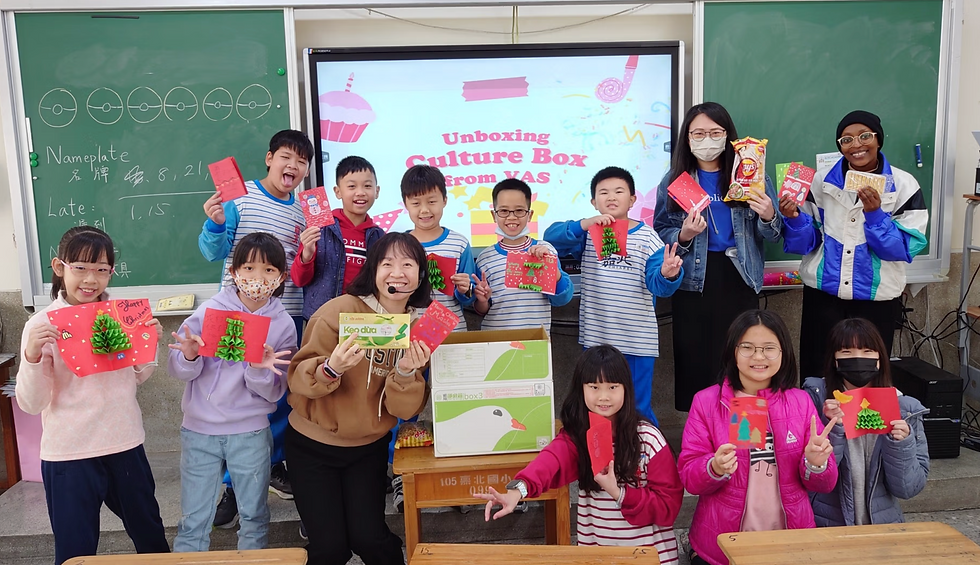
Phase 4: Cultural Exchange-the gift exchange between students.
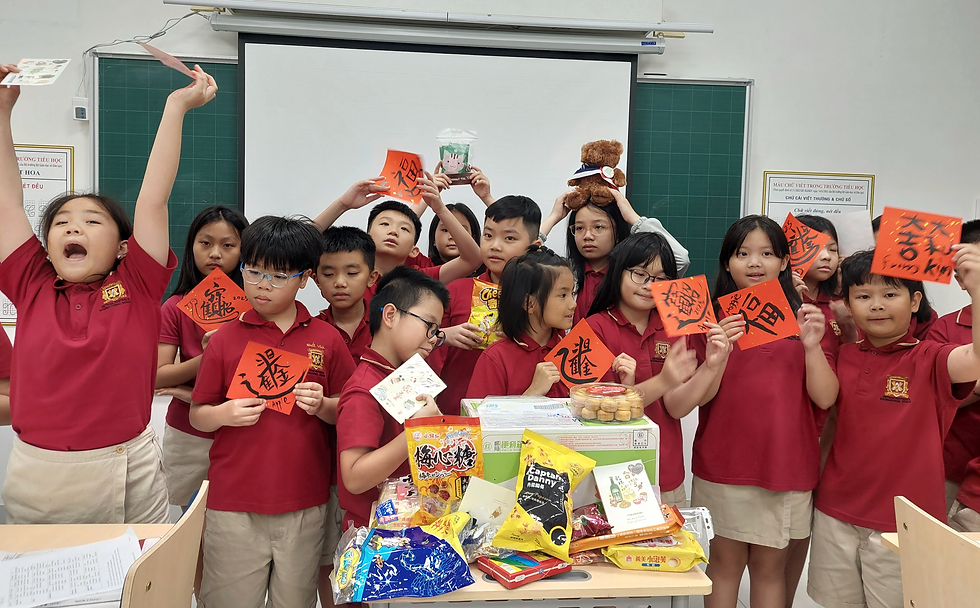
Students explored cultural elements such as Taiwanese snacks and Spring Festival couplets like “招財進寶,” learning not just the language, but also the meaning behind it.
Our Taiwanese partners brought thoughtful items, including snacks, handwritten Spring Festival couplets. In return, our VAS students also prepared handmade Christmas cards and small gifts of their own. It was clear what they were trying to do: they were sharing a part of themselves.
This moment brought everything together—language, culture, and human connection.
For many students, this was their first time giving something to someone from another country, and receiving something in return. It made the idea of “exchange” feel real.
Phase 5: The School Visit (May 19th, 2025)-When Friendships Started to Feel Real
A huge thank you to our Head of Primary, Ms. Gigi, our MFL Coordinator, Mr. Eugene Azor, and the entire MFL and Primary teaching teams! One of the most meaningful moments of the project was when our Taiwanese partner school visited the Sala campus.

After months of online interaction, students finally met face-to-face.There was excitement, a bit of nervousness, and a lot of curiosity.
From the moment they arrived, our students naturally stepped into the role of hosts:
welcoming their guests
guiding them around campus
trying their best to communicate
During classes and STEM activities, students worked together to solve problems.When language wasn’t enough, they used gestures, demonstrations, and teamwork. Slowly, something began to shift. At first, students stayed within their own groups.But over time, they started to:
sit together
talk
laugh
connect
By the end of the day, they were no longer just visitors—they were friends.

5. Assessment Design
This project was assessed through observation and participation rather than traditional tests.

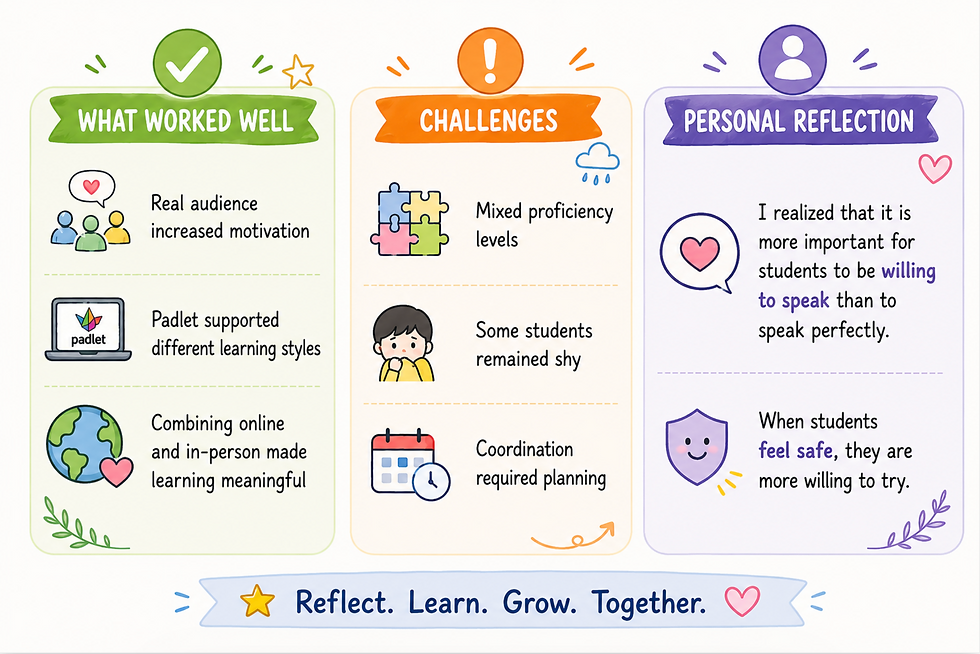
6. Reflection on Teaching Practice
7. Next Steps
Moving forward, I plan to:
Add more structured conversation tasks
Pair students for deeper interaction
Introduce small collaborative projects
Include more student reflection
Final Reflection
This project made one thing very clear:
When language has a real purpose, learning becomes meaningful.
Students are not just learning Chinese or English.They are learning how to connect, understand others, and communicate beyond the classroom.
And those are the skills that truly transfer.



Comments