Back-to-School Reset: From Classroom Rules to Shared Ownership

A new school year often comes with new lesson plans, new students, new classroom displays, and new learning goals. But before I begin teaching content, there is one thing I want my students and I to establish together:
How do we want to learn together?
For me, classroom norms are not simply a list of rules that a teacher gives students on the first day. They are something we build together.
It Starts With a Conversation
During the first week of school, I want to spend time talking with my students about why classroom norms matter. Instead of simply saying:
“Here are our classroom rules.”
I want to ask:
What rules do you think are important for our classroom?
Why do you think they are important?
What might happen if we don't follow them?
Students have time to think, share their ideas, listen to different perspectives, and explain their reasoning. Then, as a class, we discuss the ideas and vote on the norms we believe are most important. The goal is not for me to decide everything. The goal is to develop a shared understanding and agreement about how we want our classroom to feel and function. Eventually, we will build our classroom norms around three simple ideas.
Three Norms We Create Together
1. Be Respectful and Kind
Respect yourself, others, and our learning space.
Use kind language, listen to others, take care of our classroom, and support one another.
2. Participate and Be Prepared
Come ready to learn.
Share your ideas, ask questions, listen actively, and contribute to our learning community.
3. Try, Make Mistakes, and Grow
Learning does not always look perfect.
Take risks, make mistakes, ask for help, reflect, and try again.
These three ideas may sound simple, but the important part is not simply writing them on the wall.
Students need opportunities to practice them.
Rules Are Not Just Written on the Wall
Creating the norms is only the beginning. During the first part of class, these norms become part of our daily routine. I use simple hand signals.
When I hold up one finger, the class responds:
“Be Respectful and Kind!”
Two fingers:
“Participate and Be Prepared!”
Three fingers:
“Try, Make Mistakes, and Grow!”
It may seem simple, but repetition helps turn the words into something familiar.
Over time, I hope students won't just remember the words. They will understand what the words mean and recognize what they look like in action.
A Simple Gesture Can Be a Reminder
Students will forget, and that's okay. If a classroom norm is forgotten during a lesson, I don't necessarily want to stop everything for a long lecture about behavior. Sometimes, I can simply pause and use the hand signal.
For example, if students are talking over one another, I might hold up one finger.
The class responds: “Be Respectful and Kind.” Then we continue learning. The reminder becomes part of the learning environment rather than a public reprimand. It is simply a reminder:
“Hey, remember what we agreed on?”
I want students to gradually learn to recognize their own behavior instead of always waiting for the teacher to tell them what they did wrong.
Accountability Matters Too
Of course, classroom management cannot rely on reminders alone.
Students also need to understand that shared agreements come with shared responsibility. Since I often organize my classes into three teams, I use a simple team-based point system to encourage students to support one another and take responsibility for their choices. Students are given opportunities to recognize and adjust their behavior before a consequence is applied.
In my classroom, I typically use three opportunities as part of this management structure. The first reminder might come from me. After that, I want to give students opportunities to support and remind one another. This is where the power of the team comes in.
Instead of the teacher constantly correcting individual students, classmates can help each other remember the norms they created together. If the behavior continues after these opportunities, the team may lose one point. But there is something very important about this system:
A Mistake Is Not the End. The Next Choice Matters.
If the student recognizes the problem and immediately adjusts their behavior, I restore the point. Sometimes, I may even give an extra point to a student who appropriately helps remind a teammate. Why?
Because I don't want students to learn: “I made a mistake, so I lost a point.”
I want them to learn:
“I made a mistake, but I can make a better choice and repair the situation.”
For me, accountability is not simply: Mistake → Punishment → End
It is: Reminder → Recognition → Choice → Correction → Restoration
The consequence is not meant to be the end of the story. It creates an opportunity for students to recognize what happened, make a different choice, and repair the outcome. And this connects directly to our third classroom norm:
Try, Make Mistakes, and Grow.
Students can make mistakes in their learning, reflect, and try again.
I believe they should have the same opportunity with their behavior.
Making a mistake is not the end of the story. The next choice matters.
I Want Students to Be Supporters, Not Monitors
Because we work in teams, I also want to gradually give some responsibility back to the students. Team members can remind one another:
“Remember our norm.”
“Let’s get back on track.”
But I don't want students to become monitors who are constantly watching for someone else to make a mistake. I want them to become supporters. There is a big difference.
When students remind one another respectfully rather than laughing, blaming, or reporting on each other, they are actually practicing our first norm:
Be Respectful and Kind. They are also developing shared responsibility.
This is not just the teacher's classroom. It is our learning community.
Rewards Become Choices
When teams demonstrate strong participation, preparation, respect, and teamwork, I don't necessarily want to give them a physical prize. I prefer to give them something I value more: choice.
For example, during the last few minutes of class, teams that have earned the privilege may choose the interactive review game we use.
Kahoot? Blooket? Or another game the class enjoys?
It may seem like a small reward, but it sends an important message:
“Your effort and teamwork helped shape what happens next in our classroom.”
The reward is not simply: “You behaved, so you get a prize.”
It becomes:
“Your choices have consequences—and your positive choices can create more choices.”
And I think that distinction matters. The goal of classroom management isn't to make students behave because they are afraid of losing points. It is to help students gradually develop the ability to manage themselves, support one another, and make responsible choices.
From Compliance to Ownership
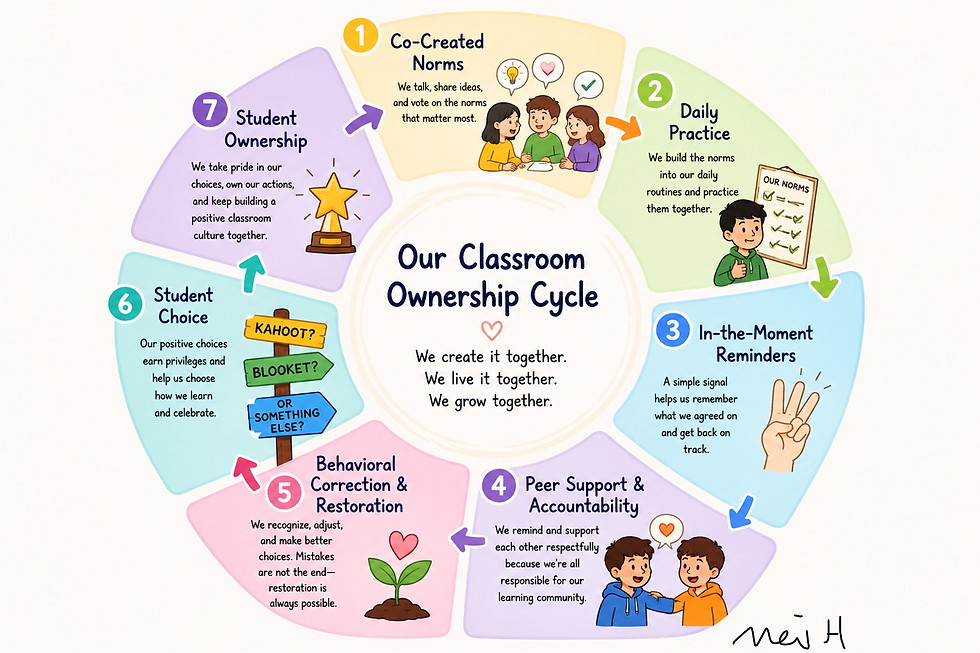
When I look at the whole process, I see it as a cycle:
Co-Created Norms➡️Daily Practice➡️In-the-Moment Reminders➡️Peer Support & Accountability➡️Behavioral Correction & Restoration➡️Student Choice➡️Student Ownership
At first, students may follow a norm simply because the teacher reminds them.
Then, they begin to understand: “This is something we agreed on together.”
Eventually, they may begin to remind themselves and support their teammates.
And my hope is that, one day, even without a teacher's reminder, a student can stop and think:
“Does this choice reflect the norms we created together?”
Because that is when classroom norms become more than classroom rules.
They become part of the culture of the classroom. For me, a Back-to-School Reset is not simply about resetting behavior. It is about creating an opportunity for students to learn something much bigger:
How to manage themselves.
How to support others.
How to take responsibility for their choices.
And perhaps most importantly: How to recognize that making a mistake does not mean they are stuck with it. They can always reflect, make a better choice, and try again. The goal isn't simply to make students better at following rules.
The goal is to help them gradually move from compliance to ownership.
Because the strongest classroom norms aren't necessarily the ones written by the teacher. They are the ones students understand, believe in, practice, and help create.
Comments